
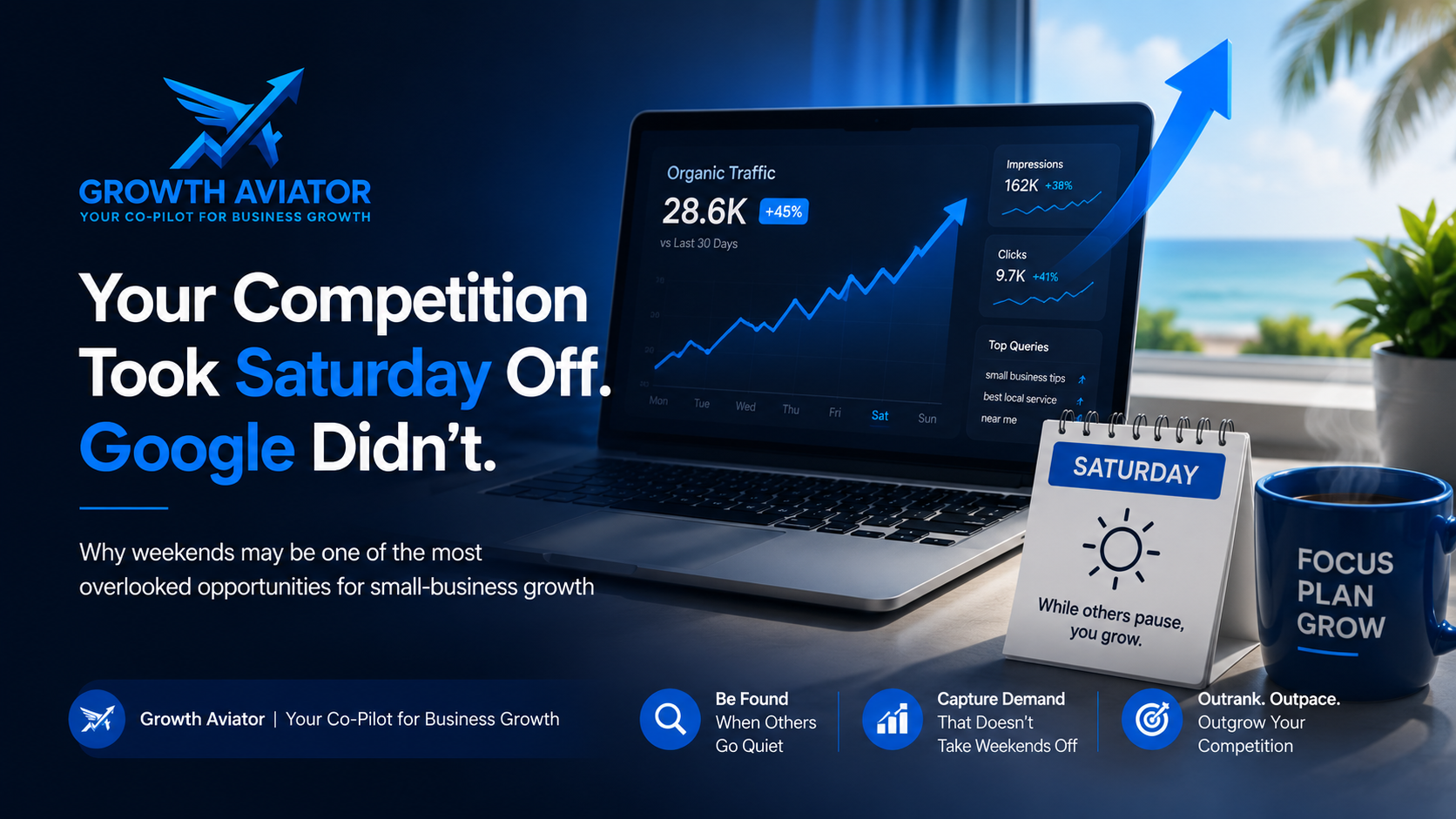
Why weekends may be one of the most overlooked opportunities for small-business growth
Some business owners are finally stepping away from the phone. Others are catching up on paperwork, spending time with family, mowing the lawn, watching a game, or enjoying the first quiet moment they’ve had all week.
It’s Saturday.
And there is absolutely nothing wrong with that.
But while businesses slow down for the weekend, something interesting happens:
Customers don’t stop searching.
Google doesn’t close.
Your website doesn’t take Saturday off.
Your social media profiles are still being viewed.
Your competitors are still appearing in search results.
Potential customers are still comparing companies, reading reviews, checking websites, looking at prices, researching services, and deciding who they may contact Monday morning.
That creates an opportunity most small businesses completely overlook.
The Weekend Advantage
Monday through Friday, everybody is fighting for attention.
Your customer’s inbox is full.
Their phone is ringing.
Their employees need something.
Meetings are happening.
Deadlines are approaching.
Social media is moving at full speed.
Then Saturday arrives.
The pace changes.
People have more time to browse.
More time to research.
More time to finally look into the contractor they need.
The website they’ve been meaning to build.
The new office furniture they’ve been considering.
The HVAC company they may need.
The lawn service they’ve been thinking about calling.
The marketing problem they know they need to fix.
This is why Saturday shouldn’t automatically be treated like a dead marketing day.
It may simply require a different type of marketing.
Instead of shouting louder, Saturday is a great day to be more useful.
More interesting.
More human.
And more memorable.
Your Business Is Working Even When You Aren’t
One of the biggest advantages of modern digital marketing is that your business can continue working long after you finish working.
Think of your website as a salesperson who never goes home.
At 2:00 on a Tuesday afternoon, someone might visit your website.
At 9:30 on Saturday night, someone else might do the exact same thing.
They may never call at that moment.
But they are forming an opinion.
Within seconds, they are subconsciously asking questions like:
Does this company look legitimate?
Can they solve my problem?
Do they work in my area?
Do they seem trustworthy?
Are they better than the other three companies I just looked at?
And there is one question that matters most:
“Should I contact them?”
Your website has to answer that question whether you are sitting behind your desk or sitting by the pool.
That is the beauty of building the right digital systems.
Your business keeps flying even when the pilot isn’t in the cockpit.
Saturday Is When People Notice the Things They’ve Been Ignoring
There’s another reason weekends can be valuable.
People finally have time to notice problems.
They walk outside and see the landscaping that needs attention.
They sit in the living room and remember the remodeling project.
They notice the air conditioner isn’t cooling quite right.
They finally research the new office chair they need.
They open their laptop and realize their company’s website looks ten years older than the competitor’s.
They search their business on Google and discover the competitor across town appears above them.
During the week, those problems get pushed aside.
On Saturday, people finally have time to investigate them.
The question is:
Will they find you when they start looking?
Being Online Is Not the Same as Being Visible
Many businesses technically have an online presence.
They have a website.
They have a Facebook page.
Maybe they created an Instagram account.
They have a Google Business Profile.
They may even have a few reviews.
But that doesn’t necessarily mean customers are finding them.
There is an important difference between existing online and being visible online.
Visibility comes from multiple pieces working together.
Your website needs to clearly explain what you do.
Google needs to understand what services you provide and where you provide them.
Your business information needs to be accurate.
Your content needs to demonstrate expertise.
Your reviews need to build trust.
Your social media needs to remind people that you exist.
Your calls to action need to tell visitors exactly what to do next.
When these systems work together, something powerful happens.
A customer may discover your company on Google.
Visit your website.
Read one of your articles.
Look at your reviews.
Visit your Facebook page.
See that you are active.
And then contact you.
That entire customer journey may happen without you ever speaking to them until the final step.
That is what a strong digital presence is supposed to do.
The Best Marketing Doesn’t Always Feel Like Marketing
Saturday audiences usually don’t want another hard sales pitch.
They don’t want:
BUY NOW!
LIMITED TIME!
CALL TODAY!
DON’T MISS OUT!
Sometimes the best way to get attention is simply to answer a question someone already has.
Imagine you own an HVAC company.
Instead of posting:
“Call us for AC repair!”
You could publish:
“Why Your AC Feels Fine During the Day but Struggles at Night”
If you own a landscaping company:
“5 Signs Your Lawn Problem Isn’t Actually a Watering Problem”
If you own an office furniture company:
“Before You Buy New Office Furniture, Try These 3 Changes First”
If you own a roofing company:
“The Saturday Morning Roof Check That Could Save You Thousands”
These topics create curiosity.
And curiosity creates clicks.
That is exactly what good content should do.
Your Website Should Answer Questions Before Customers Ask Them
One of the easiest ways to improve a website is to stop thinking about what the business wants to say and start thinking about what the customer wants to know.
Customers usually want answers to simple questions.
What do you do?
Can you help someone like me?
Where do you work?
How much does this typically cost?
Why should I trust you?
What happens after I contact you?
How quickly can you help?
What makes you different?
If your website forces visitors to hunt for those answers, you are creating friction.
And online friction costs businesses customers.
Your homepage doesn’t need to tell your entire company history.
It needs to help the right customer quickly understand:
“Yes. I’m in the right place.”
Google Visibility Is Becoming Part of Your Reputation
Years ago, people might have discovered businesses primarily through referrals, newspaper ads, radio, signs, or the Yellow Pages.
Those methods still have value.
But today, even referred customers frequently perform another step:
They Google you.
Someone says:
“Call ABC Plumbing. They’re great.”
The customer pulls out their phone and searches:
ABC Plumbing
What they see next matters.
A complete business profile?
Strong reviews?
Recent photos?
A professional website?
Useful information?
Or an outdated website and a business profile that looks abandoned?
Your digital presence now acts as a second opinion.
Even when somebody recommends you, the internet often gets the final vote.
This Is Why Consistency Beats the Occasional Marketing Sprint
A lot of businesses market in bursts.
Business gets slow.
They panic.
They start posting.
They run an ad.
They send an email.
They update their website.
Business improves.
Marketing stops.
Then three months later, the cycle repeats.
A stronger approach is much simpler:
Keep showing up.
One useful blog this week.
A few meaningful social posts.
Ask customers for reviews.
Improve one website page.
Add one helpful FAQ.
Update one service description.
Publish one local article.
Optimize one Google Business Profile section.
None of these tasks feel revolutionary individually.
But when repeated consistently, they compound.
Six months later, you don’t have one article.
You have 25.
You don’t have three reviews.
You have 30.
You don’t have an empty social profile.
You have a library of useful content.
You don’t have a website that simply exists.
You have a website that helps generate business.
That is how digital growth usually happens.
Not through one magic marketing trick.
Through consistent altitude gain.
AI Makes This Easier — But Only If You Use It Correctly
Artificial intelligence is changing marketing dramatically.
Businesses can now create:
- Blog ideas
- Social content
- Email campaigns
- Customer follow-ups
- Website copy
- FAQs
- Lead responses
- Marketing research
- Automated workflows
faster than ever.
But there is a trap.
Businesses can generate more content without necessarily creating better content.
If every company publishes the same generic AI-generated advice, customers eventually stop paying attention.
AI should help businesses become more efficient.
It should not remove the business’s personality.
The strongest content combines technology with something AI cannot manufacture on its own:
Your experience.
Your customers.
Your stories.
Your opinions.
Your local market knowledge.
Your victories.
Your mistakes.
Your personality.
That is what makes content worth reading.
AI should be the co-pilot.
Your business still needs a pilot.
What Is Working While You’re Reading This?
Here’s an interesting exercise.
Open your business website in another browser tab.
Pretend you have never seen the company before.
Give yourself ten seconds.
Now answer these questions:
Do I immediately understand what this company does?
Do I know who they serve?
Do I know where they operate?
Do I see a clear reason to choose them?
Is there an obvious next step?
Does the company look active?
Does the website feel current?
Would I trust this company with my money?
If you hesitate on several of those questions, your customers may be hesitating too.
And sometimes the biggest growth opportunity isn’t adding something new.
It’s fixing what is already there.
The Businesses That Win Online Usually Aren’t Doing Everything
They’re doing the important things consistently.
You do not need to dominate every social network.
You do not need to publish a blog every day.
You do not need twenty complicated marketing systems.
And you certainly do not need to chase every new AI tool that appears.
You need a clear flight plan.
Know where customers are coming from.
Know what they see when they find you.
Know what is stopping them from contacting you.
Then improve those areas one at a time.
That is much more effective than randomly trying new marketing tactics every month.
While Your Competition Takes Saturday Off…
You don’t need to spend your entire weekend working.
That defeats the point.
The goal is to create systems that continue working for you.
A strong website can answer questions.
SEO can help customers discover you.
Content can build authority.
Social media can keep your company visible.
Reviews can build trust.
Automation can follow up with leads.
AI can reduce repetitive work.
Together, those systems create something every business owner wants:
Growth that doesn’t depend on doing everything manually.
Because the goal isn’t to work seven days a week.
The goal is to build a business that doesn’t completely stop growing when you do.
So enjoy your Saturday.
Take the afternoon off.
Go outside.
Watch the game.
Spend time with the family.
But remember:
Your customers are still searching.
Your competitors are still showing up.
Google is still running.
And somewhere right now, someone may be looking for exactly what your business provides.
The only question is:
Will they find you?
Ready to See How Your Business Is Flying?
Growth Aviator helps businesses identify gaps in their websites, Google visibility, SEO, content, marketing, automation, and AI systems — then creates a practical flight plan for improvement.
Start with our complimentary Flight Assessment and discover where your business is gaining altitude, where you may be losing opportunities, and what you can improve next.
Growth Aviator
Your Co-Pilot for Business Growth
Stop guessing where your marketing needs help.
Take the Flight Assessment and find out.
